
You’re brushing your teeth. Half-awake. Going through the motions.
Then you pause.
Something looks… off.
A tiny dark spot. A faint shadow. Maybe just a trick of the light. You rinse, look again, tilt your head like that’s going to change reality.
And suddenly the question shows up:
What does a cavity look like, and is this one?
Let’s break it down without the dental jargon, because cavities don’t always look the way you expect, and they don’t always hurt when they should.
First: Cavities Don’t Start as Holes
Here’s the misconception: people think cavities are obvious, big holes, visible damage, undeniable pain.
Reality? Much subtler.
A cavity (tooth decay) usually begins as demineralization, a slow breakdown of your tooth enamel caused by bacteria and acid.
Which means early signs are easy to miss.
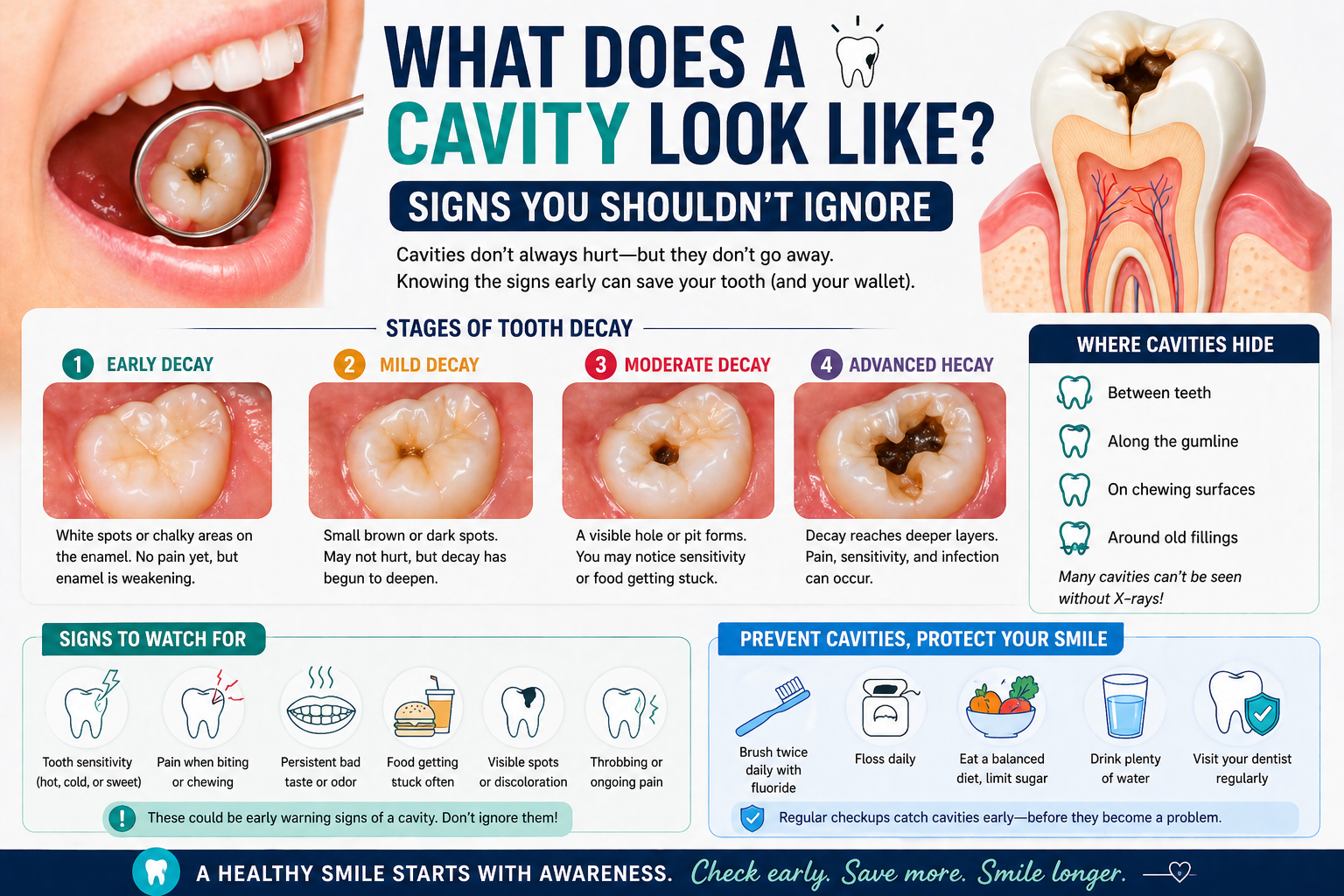
What a Cavity Looks Like (Stage by Stage)
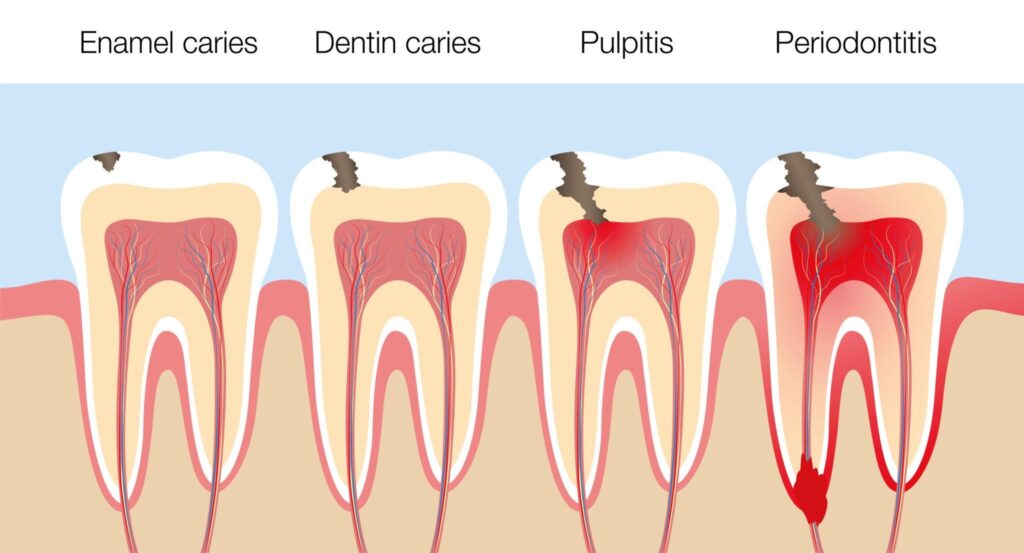
Cavities evolve. And they don’t all look the same.
1. The Early Stage: White Spots
This is where it starts.
- Chalky white patches on the tooth
- Often near the gumline
- No pain (which is why people ignore it)
At this stage, enamel is weakening, but not yet broken.
And here’s the kicker: this stage can sometimes be reversed.
2. The “Hmm, That’s New” Stage: Brown or Dark Spots
Now things are progressing.
- Light brown or dark spots
- Slight surface changes
- Still might not hurt
This is where most people first notice something, but still hesitate to act.
Because it’s not dramatic enough to feel urgent.
3. The Obvious Stage: Visible Damage
At this point, it’s no longer subtle.
- A small hole or pit
- Rough or uneven surface
- Food getting stuck more easily
Now the cavity has moved beyond enamel into deeper layers.
And yes, this is where treatment becomes necessary.
4. The Advanced Stage: Pain and Sensitivity
This is when your tooth finally speaks up.
- Sharp pain when eating or drinking
- Sensitivity to hot, cold, or sweet foods
- Persistent discomfort
By now, decay may have reached the inner part of the tooth.
Which means more extensive treatment.
Where Cavities Usually Hide
They don’t always show up front and center.
Common hiding spots:
- Between teeth
- Along the gumline
- On the chewing surfaces of molars
- Around old fillings
Which is why you can have a cavity you can’t even see.
According to the American Dental Association, regular dental exams are essential because many cavities develop in areas that aren’t visible without X-rays.
Signs You Shouldn’t Ignore (Even If It Looks Minor)
Not every cavity announces itself loudly.
But your body gives hints.
Watch for:
- Tooth sensitivity that wasn’t there before
- A persistent bad taste in your mouth
- Pain when biting down
- A visible spot that doesn’t go away
- Food constantly getting stuck in one place
These are early warnings, not inconveniences.
Why Cavities Don’t Always Hurt Right Away
This part trips people up.
Pain doesn’t show up until the cavity reaches deeper layers, like dentin or pulp.
So you can have a cavity that:
- Looks minor
- Feels like nothing
- Is actively getting worse
The Mayo Clinic explains that early tooth decay often has no symptoms, which is why it’s frequently missed.
What Causes Cavities (In Plain Terms)
It’s not just “too much sugar.”
It’s a combination of factors:
- Bacteria in your mouth
- Sugars and starches from food
- Acid production
- Time (this one matters more than you think)
Every time you eat, bacteria produce acid that weakens enamel.
Do that often enough, and the damage builds.
Can You Fix a Cavity at Home?
Short answer: not once it becomes a true cavity.
Early enamel damage (white spots)? Sometimes reversible with:
- Fluoride
- Better oral hygiene
- Diet changes
But once there’s a hole?
You’ll need a dentist.
No amount of brushing can rebuild lost tooth structure.
How Dentists Identify Cavities You Can’t See
Even if your teeth look fine in the mirror, dentists have tools you don’t.
They use:
- X-rays
- Dental probes
- Visual inspection under proper lighting
Which is why a “surprise cavity” isn’t actually a surprise, it’s just one you couldn’t detect.
What Happens If You Ignore a Cavity?
Here’s the honest timeline:
- Early stage → reversible or simple fix
- Mid stage → filling needed
- Advanced stage → root canal or crown
- Severe stage → possible tooth loss
Cavities don’t stabilize on their own. They progress.
Always.
How to Prevent Cavities (Without Overcomplicating It)
You don’t need a perfect routine, just a consistent one.
Basics that actually matter:
- Brush twice daily with fluoride toothpaste
- Floss regularly
- Limit frequent snacking (especially sugary foods)
- Stay hydrated
- Visit your dentist regularly
Simple habits. Big difference.
FAQs: What Does a Cavity Look Like?
What does a cavity look like in the early stage?
Usually a white or chalky spot on the tooth.
Are black spots always cavities?
Not always, but they should be checked.
Can a cavity go away on its own?
No. Early damage can improve, but actual cavities need treatment.
Do cavities always hurt?
No. Pain usually appears later.
How fast do cavities form?
It varies, but they can develop over weeks to months depending on diet and hygiene.
Can you see all cavities?
No. Many form between teeth or below the surface.
The Bottom Line
So, what does a cavity look like?
Not always like you expect.
Sometimes it’s:
- A faint white patch
- A tiny dark spot
- A barely noticeable change
And sometimes, it’s nothing you can see at all.
That’s the tricky part.
Because cavities don’t wait for you to notice them. They just keep going.
So if something looks off, even slightly, it’s worth checking.
Not because it’s definitely serious.
But because catching it early is the difference between a quick fix… and a much bigger problem later.
*This article is for informational purposes only and should not be taken as official legal advice*