There’s a common assumption that floats around whenever blood types come up, usually during school lessons, hospital visits, or random trivia nights:
“If you’re type O, you can donate to anyone, right?”
Close. But not quite.
If you have O positive blood type, you’re in a powerful position as a donor, but you’re not the universal donor. That title belongs to someone else.
Let’s clear up the confusion, break down the science, and explain exactly who O positive blood can help (and who it can’t).
What Does “O Positive” Actually Mean?
Before we talk about donating, we need to decode the label.
Blood types are determined by two main systems:
- ABO group (A, B, AB, or O)
- Rh factor (positive or negative)
So when you hear O positive blood type, it means:
- Your blood has no A or B antigens
- Your blood does have the Rh (D) antigen
That combination matters, a lot, when it comes to transfusions.
According to the American Red Cross, matching these factors correctly is essential to avoid dangerous immune reactions.
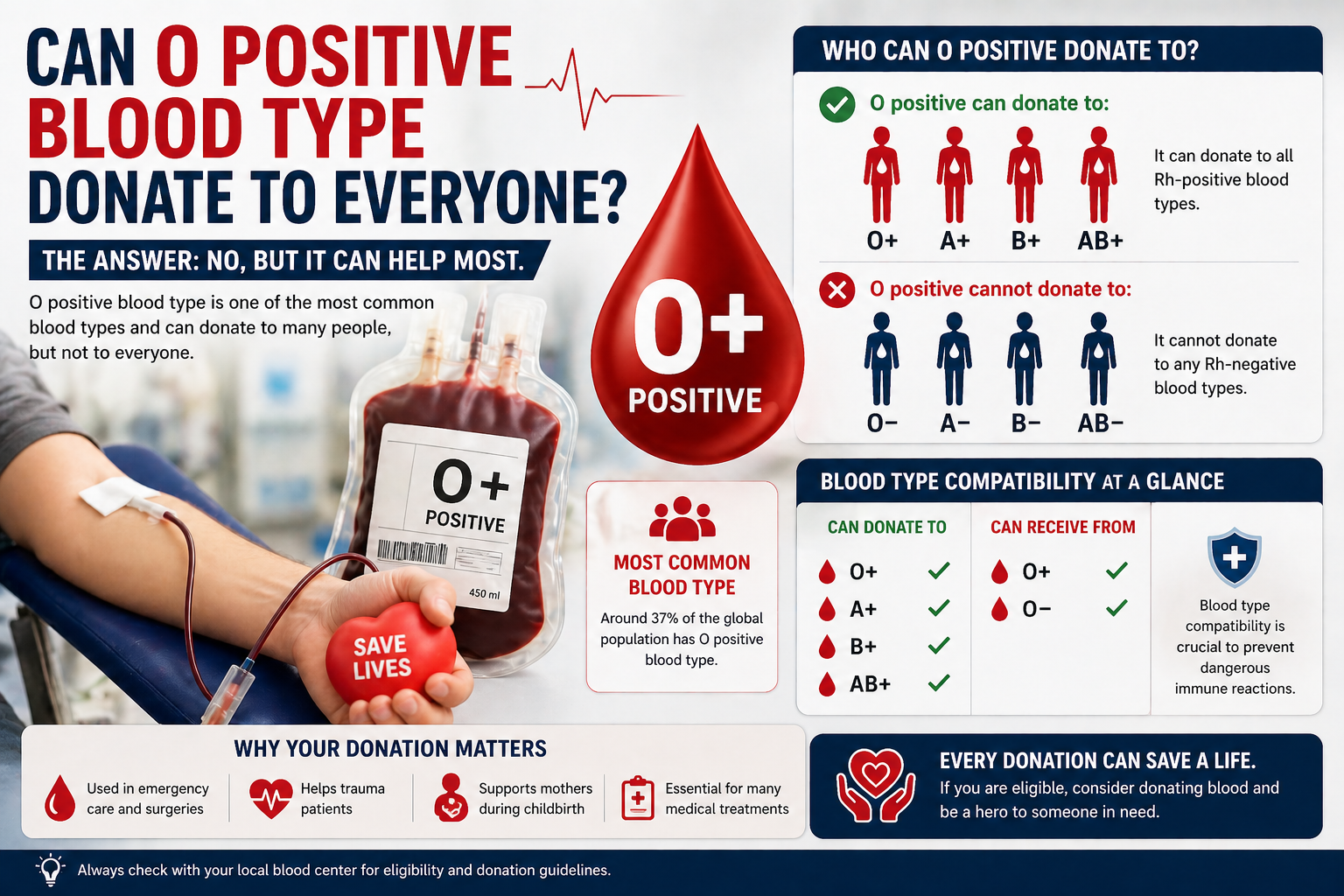
The Big Question: Can O Positive Donate to Everyone?
Short answer: No.
Longer answer: O positive blood can donate to many people, but not all.
Here’s how it works:
O Positive Can Donate To:
- O positive
- A positive
- B positive
- AB positive
That’s a large portion of the population.
O Positive Cannot Donate To:
- Any Rh-negative blood types (like O-, A-, B-, AB-)
Why? Because Rh-negative individuals cannot receive Rh-positive blood safely.
So while O positive is flexible, it’s not universal.
Who Is the Universal Donor?
That title goes to O negative blood type.
Why?
Because O negative blood:
- Has no A or B antigens
- Has no Rh factor
That means it can be given to almost anyone in emergency situations.
In contrast, O positive blood type still carries the Rh factor, so it’s slightly more limited.
Why O Positive Blood Is Still Extremely Important
Here’s the part that often gets overlooked:
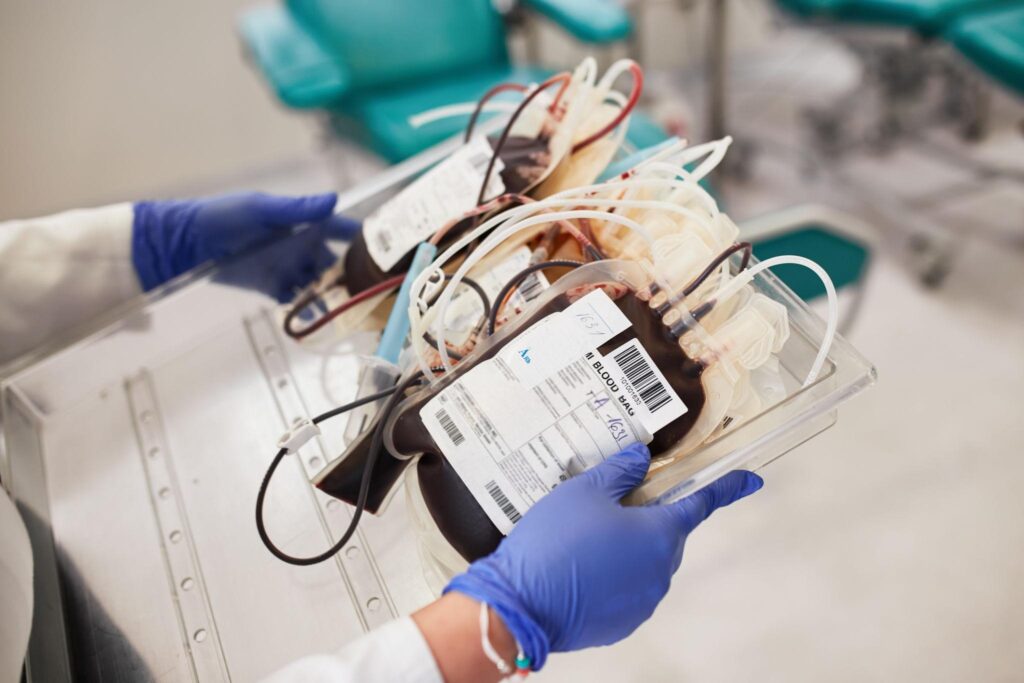
Even though O positive isn’t universal, it’s the most common blood type in the world.
That means:
- It’s in high demand
- It’s used frequently in hospitals
- It plays a major role in routine and emergency care
The World Health Organization notes that maintaining a stable blood supply depends heavily on common blood types like O positive.
So if you have this blood type, your donations matter, a lot.
Why Blood Type Compatibility Matters
Blood transfusions aren’t just about replacing lost blood, they’re about avoiding immune reactions.
If someone receives incompatible blood, their immune system may attack it.
This can lead to:
- Fever and chills
- Organ damage
- Life-threatening complications
That’s why matching ABO and Rh factors is critical.
It’s not a suggestion, it’s a requirement.
Who Can Receive O Positive Blood Safely?
Let’s simplify it.
If a person is Rh-positive, they can receive Rh-positive blood.
So O positive donors can safely help:
- Anyone with positive blood types
- Which includes a large percentage of the population
In fact, many transfusions rely on O positive blood because of its compatibility range.
Can O Positive Receive Blood From Anyone?
Now flip the question.
People with O positive blood type can receive:
- O positive
- O negative
That’s it.
Because O-type blood has anti-A and anti-B antibodies, it cannot accept A, B, or AB blood.
So while O positive donors are flexible, O positive recipients are more limited.
Why Hospitals Prioritize O Blood Types
There’s a reason hospitals pay close attention to O blood.
In emergencies, especially when there’s no time to test blood type, doctors may use:
- O negative (first choice)
- O positive (if Rh compatibility is confirmed)
That’s because O blood lacks A and B antigens, reducing the risk of reaction.
It’s a safety-first approach.
The Role of O Positive in Real-World Medicine
O positive blood is used in:
- Surgeries
- Trauma care
- Childbirth complications
- Routine transfusions
Because it’s so common, it’s often the backbone of blood bank supplies.
Without consistent donations from O positive individuals, shortages happen quickly.
Should You Donate If You Have O Positive Blood Type?
If you’re eligible, yes.
Here’s why:
- Your blood is widely usable
- It’s constantly needed
- It helps both planned procedures and emergencies
And unlike rare blood types that are used sparingly, O positive blood is used regularly.
In other words, your donation won’t sit on a shelf, it will likely be used soon.
Common Myths About O Positive Blood Type
Let’s clear a few things up.
Myth: O positive can donate to everyone
Not true. Only O negative can do that.
Myth: O positive is rare
Also false. It’s actually the most common blood type globally.
Myth: Blood type doesn’t matter much
Very false. Compatibility is critical for safe transfusions.
FAQs: O Positive Blood Type Explained
Can O positive donate to AB positive?
Yes. AB positive is the universal recipient for red blood cells.
Is O positive the universal donor?
No. That’s O negative.
Why is O positive so common?
Genetics and population distribution make it the most widespread blood type.
Can O positive receive O negative blood?
Yes. O negative is safe for all blood types.
Is O positive blood always in demand?
Yes. Because it’s widely used, it’s consistently needed.
How often can O positive donate blood?
Typically every 8–12 weeks, depending on local guidelines.
The Bottom Line
So, can O positive blood type donate to everyone?
Not quite, but it comes close.
It can help a large portion of the population, making it one of the most valuable blood types in everyday medical care.
And while it doesn’t carry the “universal donor” label, it carries something arguably more important:
Consistency. Demand. Impact.
If you have O positive blood, you’re not just part of the system, you’re a key reason it works.
*This article is for informational purposes only and should not be taken as official legal advice*