You’re mid-cleaning. The overhead light is blinding, the patient is making small talk you can’t quite answer, and somewhere between scaling and polishing, a thought sneaks in:
Wait… am I being paid enough for this?
It’s not a dramatic moment. Just a quiet, practical question. But it’s the kind that leads people down a rabbit hole, Googling, comparing states, wondering if a move could mean an extra $20K a year.
Because the truth is simple: the dental hygienist salary isn’t one number. It’s a map. And where you land on that map matters.
The Snapshot: What Dental Hygienists Actually Earn
Let’s anchor this first.
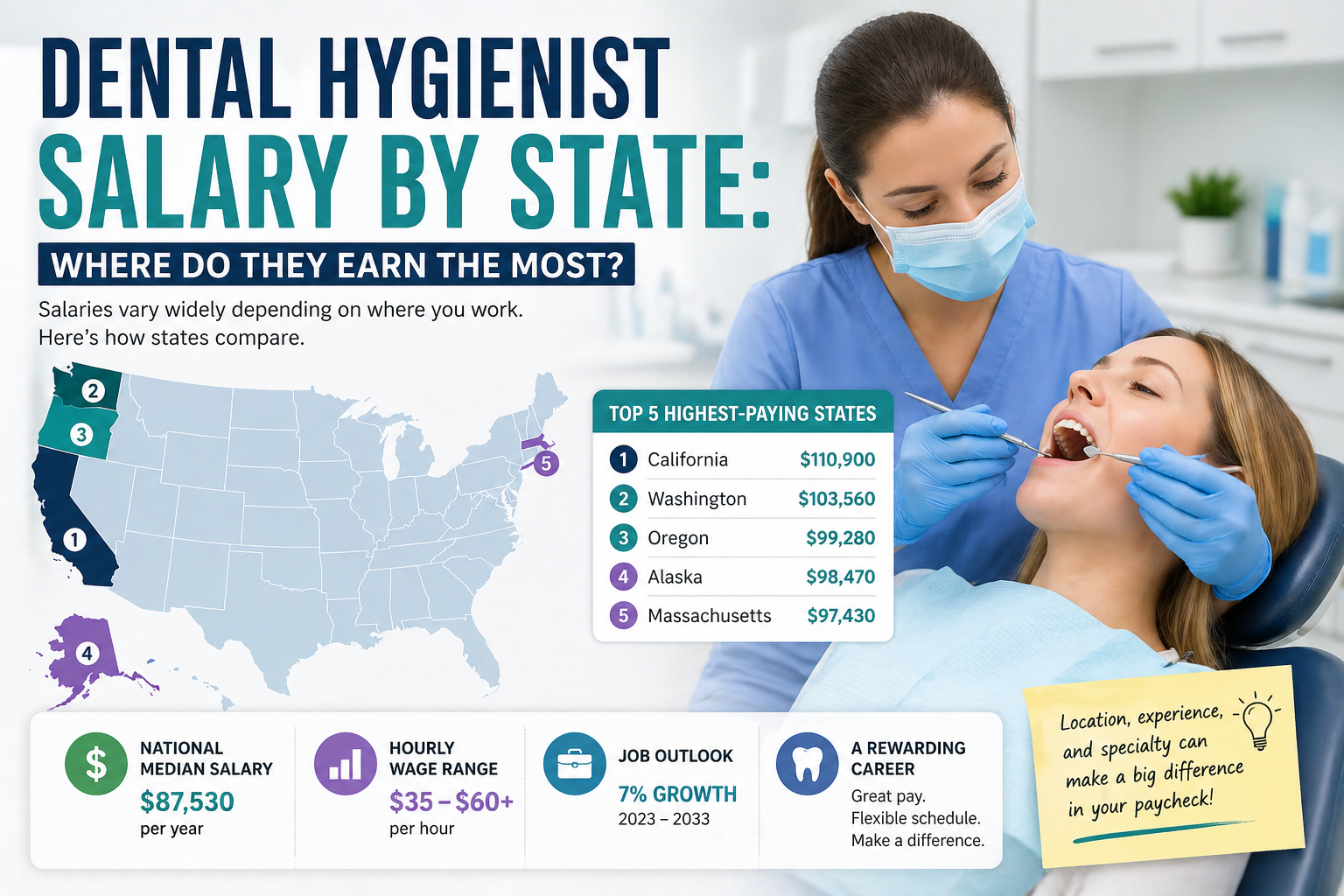
According to the U.S. Bureau of Labor Statistics, the median dental hygienist salary in the U.S. hovers between $81,000 and $90,000 per year.
That’s the headline.
But zoom in a little:
- Entry-level? Closer to $60K–$70K
- Experienced? Easily $95K+
- Top earners? Crossing six figures without blinking
And then there’s hourly pay, the real heartbeat of this profession.
Because hygienists don’t just earn annually. They negotiate by the hour. They stack shifts. They pick flexibility over predictability. (Sometimes both.)
The High Rollers: States Where Pay Jumps
Let’s not dance around it. Some states just pay more.
Top-tier earners include:
- California, often $110K+
- Washington, around $95K–$105K
- Oregon, hovering near $100K
- Alaska, high pay, fewer professionals
- Massachusetts, strong healthcare economy
Sounds great, right?
Well… yes and no.
Because that $110K in California? It’s competing with rent that could swallow half your paycheck. Still worth it? Depends on your tolerance for expensive coffee and even more expensive apartments.
Middle Ground (a.k.a. The Sweet Spot Nobody Talks About Enough)
Here’s where things get interesting, and arguably smarter.
States like:
- Texas
- Florida
- Colorado
- Arizona
…don’t always top the charts. But they quietly offer $75K–$95K salaries with a much friendlier cost of living.
Translation: your money stretches.
You might not brag about your salary at dinner. But you also won’t wince every time you check your rent payment. Small victories.
The Lower End… That Isn’t Always “Lower”
Let’s talk about the states that look underwhelming on paper:
- Mississippi
- West Virginia
- Alabama
Average salaries here hover around $60K–$75K.
Cue the hesitation.
But pause, because context matters. Lower housing costs. Cheaper groceries. Less financial pressure overall.
So the real question becomes:
Would you rather earn more, or keep more?
Hourly Pay: The Real Game-Changer
Here’s where dental hygiene quietly flips the script.
This isn’t a rigid 9-to-5 salary job. It’s flexible. Modular. Almost freelance-adjacent.
Typical hourly ranges:
- High-paying states: $45–$60/hour
- Mid-range: $35–$45/hour
- Lower range: $30–$40/hour
And here’s the twist, many hygienists don’t stick to one office.
They:
- Work part-time at multiple clinics
- Take on temp gigs
- Build schedules that actually fit their lives
It’s not just about how much you earn. It’s about how you design your work.
Why Location Changes Everything
This part isn’t random. There are clear forces behind salary differences.
Cost of Living (the obvious one)
Cities like San Francisco and Seattle demand higher wages, because everything else costs more too.
Demand for Care
More people. More dental visits. More need for hygienists. Simple math.
State Regulations
Some states give hygienists more autonomy. More responsibility = higher value = better pay.
Experience (yes, it still matters)
A seasoned hygienist can command higher rates almost anywhere. Location helps, but skill travels.
The Curveball: Best States (When You Factor Reality In)
If you only look at raw salary, California wins.
If you look at real life? Different story.
States like:
- Nevada
- Utah
- Idaho
…often come out ahead when you factor in affordability.
Meaning: your paycheck might be smaller, but your actual lifestyle is bigger.
And honestly, that’s the metric most people care about after a few years in the field.
Is Dental Hygiene Still Worth It? (Short Answer: Yes)
Let’s be blunt.
You don’t spend a decade in school. You don’t rack up overwhelming debt. And you still land in a career that pays well and offers flexibility.
The U.S. Bureau of Labor Statistics continues to project steady growth in this field, and it makes sense.
People aren’t skipping dental care anytime soon. If anything, preventive care is becoming more important.
So no, this isn’t a fading career. It’s a stable one, with room to move.
How to Actually Earn More (Without Guessing)
If you want to push your dental hygienist salary higher, here’s what actually works:
Move strategically
Not just “go where it pays most”, go where pay and cost balance out.
Stack skills
Specialties (like periodontal care) can bump your hourly rate quickly.
Negotiate
Yes, even in healthcare. Especially in private practices.
Try temp or travel work
Short-term gigs often pay more. Less stability, but higher upside.
So… Should You Relocate?
Tempting, right?
Pack up, head to Washington or Oregon, and chase the bigger paycheck.
But here’s the honest answer: maybe.
Because relocation isn’t just about income. It’s about:
- Lifestyle
- Expenses
- Job availability
- Personal priorities
The “best” state on paper might not be the best for you. And that’s not a cop-out, it’s reality.
FAQs: Quick Answers to Common Questions
What is the average dental hygienist salary?
Around $81K–$90K annually, depending on experience and location.
Which state pays the most?
California consistently ranks highest in raw salary.
Can dental hygienists earn six figures?
Yes, especially in high-paying states or with experience.
Is hourly pay better than salary?
Often, yes. It gives flexibility and can increase total earnings.
Do all hygienists work full-time?
Not at all. Many work part-time or across multiple offices.
The Bottom Line (No Fluff, Just Reality)
The dental hygienist salary question sounds simple, but it isn’t.
Because it’s not just about numbers. It’s about choices.
Where you live. How you work. What you prioritize.
You can chase the highest salary. Or you can build the best life around the salary you have.
And in this career? You actually get that option.
Not a bad deal for a job that starts with cleaning teeth, and ends with surprising financial flexibility.
*This article is for informational purposes only and should not be taken as official legal advice*