
You get your blood test results back. Numbers everywhere. Some familiar, most not.
Then one line catches your eye:
MCV
No explanation. Just a number, and maybe a flag that says “high” or “low.”
So naturally, the question kicks in:
What is MCV in blood test results, and should you care?
Short answer: yes.
Longer answer: it’s one of the simplest clues your body gives about what’s happening in your blood.
Let’s break it down in a way that actually makes sense.
First: What Is MCV in a Blood Test?
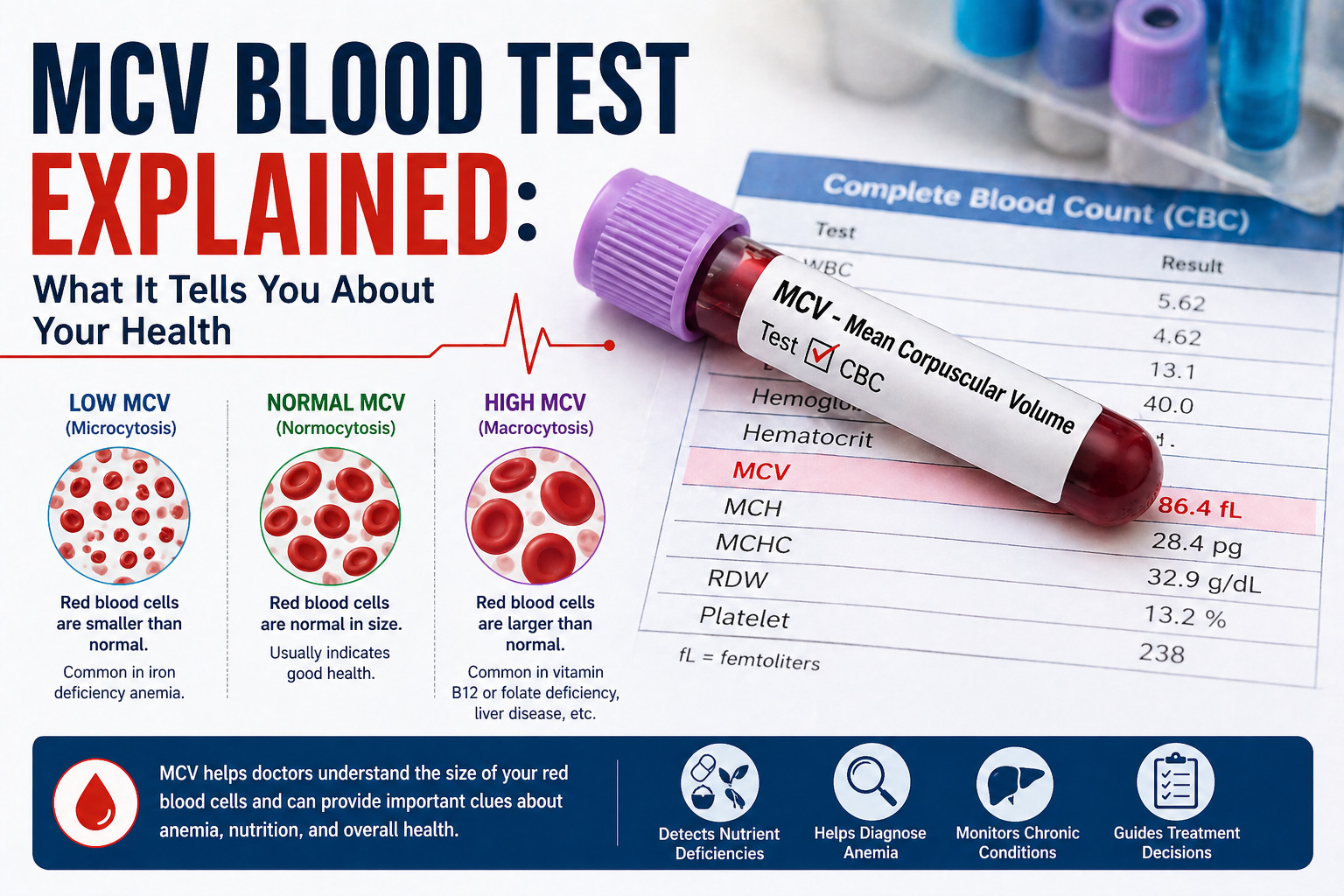
MCV stands for Mean Corpuscular Volume.
Translation? It measures the average size of your red blood cells.
That’s it. Not how many you have. Not how well they function. Just their size.
But here’s the important part:
Size matters, because it helps doctors figure out why something might be off.
Why Red Blood Cell Size Matters
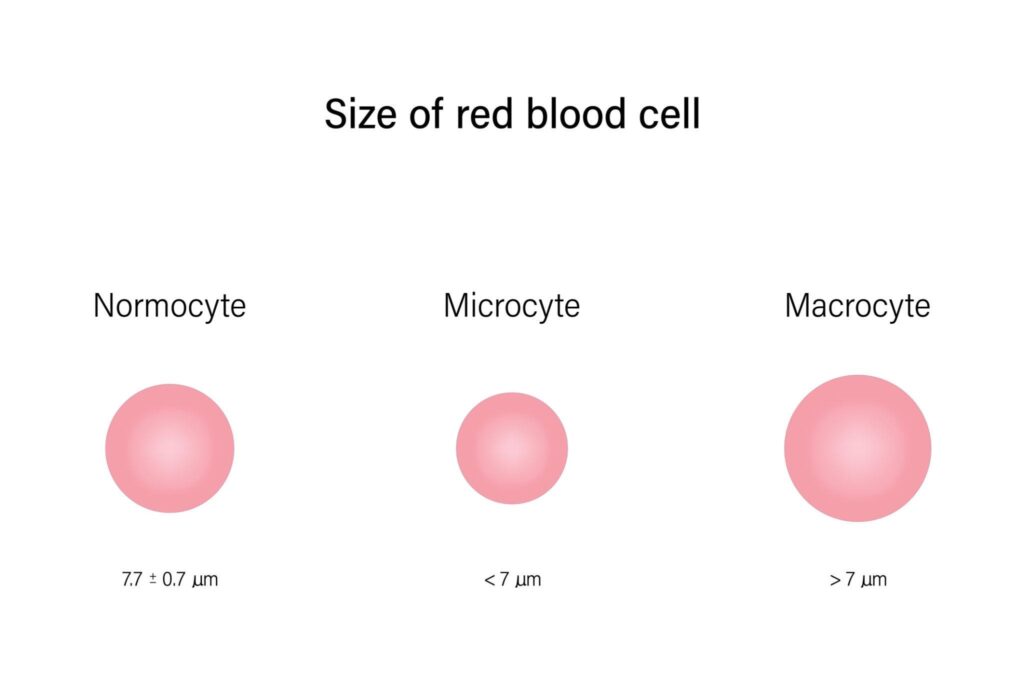
Red blood cells carry oxygen throughout your body.
When their size changes, it often signals an underlying issue.
- Too small? Something’s interfering with production
- Too large? Something’s affecting development or maturation
MCV doesn’t diagnose a condition on its own, but it points your doctor in the right direction.
What’s a Normal MCV Range?
For most adults, a normal MCV is:
80 to 100 femtoliters (fL)
(Yes, that’s a very tiny unit. Blood work loves tiny units.)
General interpretation:
- Below 80 fL → Low MCV
- 80–100 fL → Normal
- Above 100 fL → High MCV
Simple ranges. Complex meanings.
Low MCV: When Red Blood Cells Are Too Small
Low MCV is called microcytosis.
It usually points to one of the most common issues worldwide:
Iron Deficiency Anemia
Your body needs iron to make hemoglobin, the protein that carries oxygen.
Without enough iron:
- Red blood cells become smaller
- Oxygen delivery drops
- Fatigue sets in
Other possible causes include:
- Chronic blood loss
- Certain genetic conditions (like thalassemia)
According to the National Heart, Lung, and Blood Institute, iron deficiency is a leading cause of anemia globally.
High MCV: When Red Blood Cells Are Too Large
High MCV is called macrocytosis.
This often points to issues with cell development.
Common causes include:
- Vitamin B12 deficiency
- Folate deficiency
- Liver disease
- Alcohol use
- Certain medications
When red blood cells grow larger than normal, they may not function efficiently.
And again, MCV doesn’t confirm the cause. It suggests where to look.
Normal MCV (But Still Not “Normal”)
Here’s where things get tricky.
You can have a normal MCV and still have a problem.
Because MCV is just one piece of the puzzle.
Doctors also look at:
- Hemoglobin levels
- Red blood cell count
- Hematocrit
- Other indices (like MCH and RDW)
The Mayo Clinic emphasizes that blood test results must be interpreted together, not in isolation.
So a “normal” MCV doesn’t automatically mean everything is fine.
Symptoms Linked to Abnormal MCV Levels
MCV itself doesn’t cause symptoms, but the underlying conditions do.
Low MCV symptoms:
- Fatigue
- Weakness
- Pale skin
- Shortness of breath
High MCV symptoms:
- Fatigue
- Memory issues (in B12 deficiency)
- Tingling in hands or feet
- Difficulty concentrating
Sometimes symptoms are subtle. Sometimes they’re not.
What Causes MCV Levels to Change?
MCV shifts when something interferes with how red blood cells are made.
Key factors include:
- Nutritional deficiencies (iron, B12, folate)
- Chronic diseases
- Bone marrow conditions
- Alcohol consumption
- Medications
Your body is constantly producing new blood cells.
If something disrupts that process, even slightly, it shows up in your MCV.
How Doctors Use MCV in Diagnosis
MCV is rarely the final answer.
It’s more like a starting point.
Example:
- Low MCV → check iron levels
- High MCV → check B12 and folate
- Normal MCV + symptoms → dig deeper
It helps narrow the field.
Think of it as a direction, not a destination.
Can You Fix Abnormal MCV Levels?
You don’t treat MCV directly, you treat the cause.
If it’s iron deficiency:
- Iron supplements
- Dietary changes
If it’s B12 deficiency:
- Supplements or injections
If it’s related to lifestyle:
- Reducing alcohol intake
- Adjusting medications (with medical guidance)
Once the underlying issue improves, MCV often returns to normal.
Should You Be Worried About Your MCV Result?
Not automatically.
A slightly high or low MCV doesn’t always mean something serious.
But it does mean something worth understanding.
You should follow up if:
- Your MCV is significantly outside the normal range
- You have symptoms
- Other blood values are abnormal
Context matters more than the number itself.
Why MCV Is Often Overlooked (But Shouldn’t Be)
Most people focus on:
- Cholesterol
- Blood sugar
- White blood cells
MCV doesn’t get much attention.
But it quietly reveals:
- Nutritional status
- Bone marrow function
- Possible hidden deficiencies
It’s one of those markers that doesn’t shout, but still matters.
FAQs: What Is MCV in Blood Test?
What does MCV measure?
The average size of your red blood cells.
Is high MCV dangerous?
Not necessarily, but it may indicate underlying issues like vitamin deficiencies.
What does low MCV mean?
Often linked to iron deficiency or certain genetic conditions.
Can dehydration affect MCV?
Not significantly compared to other blood values.
How do I lower or raise my MCV?
By treating the underlying cause, not the number itself.
Is MCV included in all blood tests?
It’s part of a complete blood count (CBC), which is very common.
The Bottom Line
So, what is MCV in blood test results?
It’s a simple measurement with surprisingly useful insight.
It tells you whether your red blood cells are:
- Too small
- Too large
- Or just right
And from that, it helps uncover what your body might be missing, or struggling with.
It’s not the headline number on your lab report.
But it’s one of the most quietly informative ones.
And sometimes, those are the ones worth paying attention to.
*This article is for informational purposes only and should not be taken as official legal advice*