You weren’t expecting anything dramatic. Just a routine urine test. Maybe part of a checkup, maybe something your doctor ordered “just to be safe.” Then the results come back, and there it is:
Leukocytes: present.
Not exactly a word that invites calm.
So what does it mean? Should you worry? Or is this one of those lab results that sounds more serious than it actually is?
Let’s break down leukocytes in urine, what’s normal, what’s not, and when it actually matters.
First, What Are Leukocytes?
Leukocytes are simply white blood cells, your body’s defense system. They’re the first responders when something’s off, especially infections.
Normally, these cells circulate in your bloodstream. They’re not supposed to hang out in your urine in noticeable amounts.
So when leukocytes show up in a urine test, it usually means one thing:
Your body is reacting to something.
What Counts as “Normal” Leukocytes in Urine?
Here’s the part that often gets misunderstood.
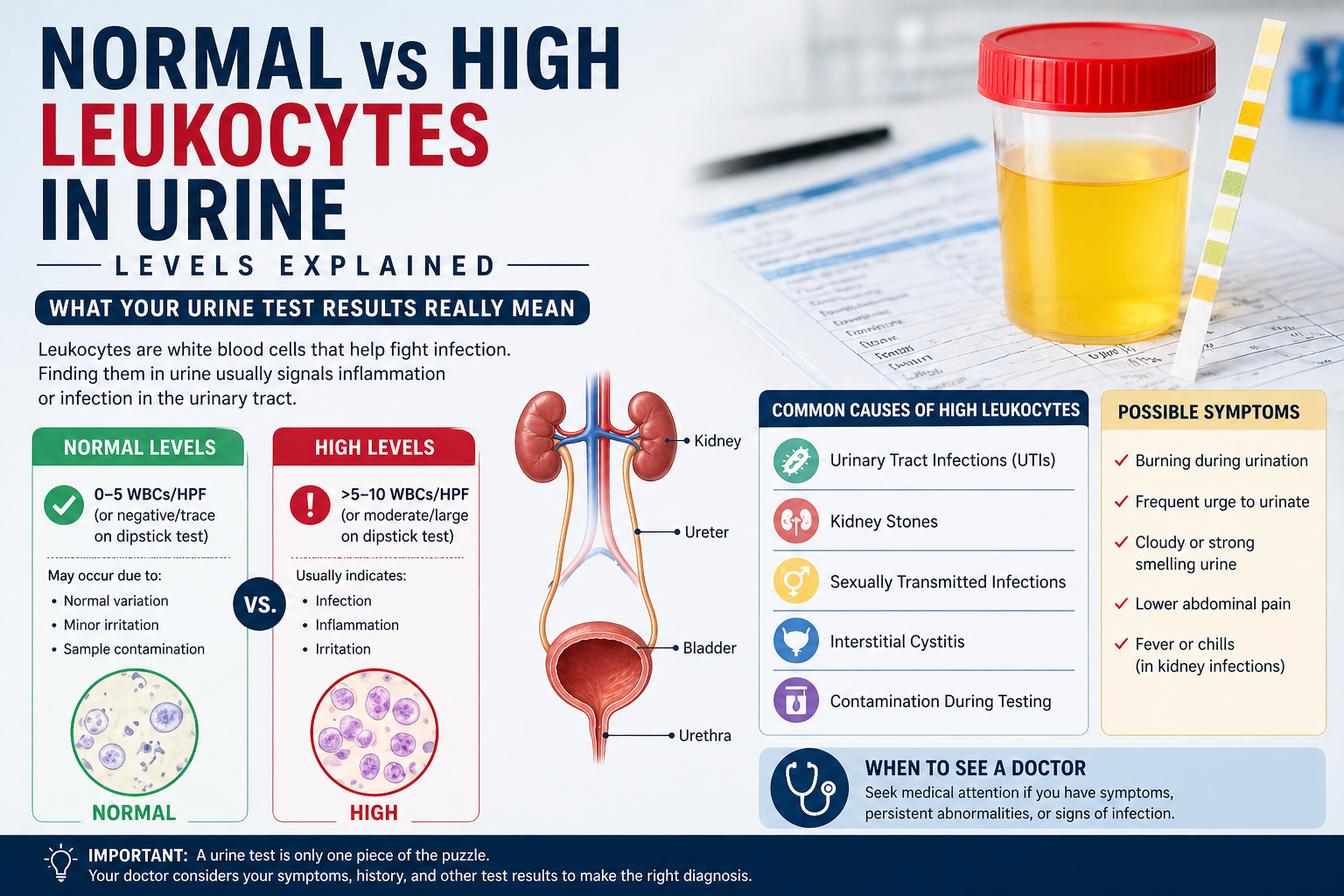
A small number of leukocytes in urine can be completely normal. Labs typically measure this in one of two ways:
- Microscopic exam: 0–5 white blood cells per high-power field (HPF)
- Dipstick test: Negative or trace amounts
Anything within that range? Usually not a concern.
In fact, minor traces can happen due to:
- Slight contamination during sample collection
- Mild, temporary irritation
- Normal variations in the body
So seeing “trace leukocytes” on a report doesn’t automatically mean something is wrong.
When Leukocytes Are Considered High
Things shift when the numbers climb.
High levels of leukocytes in urine may show up as:
- Moderate or large on dipstick tests
- More than 5–10 WBCs per HPF under a microscope
This is where doctors start paying closer attention.
Because elevated leukocytes usually signal inflammation or infection somewhere in the urinary tract.
The Most Common Cause: Urinary Tract Infections (UTIs)

Let’s not overcomplicate it, most of the time, high leukocytes in urine point to a urinary tract infection (UTI).
UTIs occur when bacteria enter the urinary system and start multiplying. Your immune system responds by sending leukocytes to fight the infection.
That’s what shows up in your test.
According to the National Institute of Diabetes and Digestive and Kidney Diseases, UTIs are among the most common infections, especially in women.
Typical UTI symptoms include:
- Burning during urination
- Frequent urge to urinate
- Cloudy or strong-smelling urine
- Lower abdominal discomfort
But here’s the twist, sometimes there are no symptoms at all.
Other Causes of High Leukocytes in Urine
UTIs are the main suspect, but not the only one.
1. Kidney Infections (More Serious)
If the infection travels upward, it can affect the kidneys.
Symptoms may include:
- Fever
- Back pain
- Nausea
This requires prompt treatment.
2. Kidney Stones
Kidney stones can irritate the urinary tract lining, triggering an immune response, and yes, leukocytes show up.
3. Sexually Transmitted Infections (STIs)
Certain infections, like chlamydia, can cause inflammation that leads to elevated leukocytes in urine.
4. Interstitial Cystitis
A chronic condition causing bladder pressure and pain, without a bacterial infection.
Leukocytes may still be present due to ongoing inflammation.
5. Contamination During Testing
Sometimes the issue isn’t inside your body, it’s in the sample.
Improper collection can introduce:
- Skin cells
- Bacteria
- Vaginal discharge
Which can lead to a misleading result.
What If You Have Leukocytes but No Symptoms?
This is where things get confusing, and surprisingly common.
You might have:
- Elevated leukocytes
- No pain
- No urgency
- No discomfort
So… now what?
This condition is sometimes called asymptomatic pyuria.
According to clinical guidance from the Mayo Clinic, doctors often look at the full picture before deciding on treatment.
Because not every abnormal test result needs action.
How Doctors Confirm the Cause
A single urine test isn’t always enough.
To understand what’s really going on, doctors may order:
- Urine culture – identifies bacteria
- Repeat urinalysis – confirms accuracy
- Imaging tests – if stones or structural issues are suspected
It’s less about the number, and more about the context.
Should You Be Worried?
Short answer: not immediately.
Longer answer: it depends.
Here’s a quick way to think about it:
- Low leukocytes + no symptoms → Usually nothing serious
- High leukocytes + symptoms → Likely infection
- High leukocytes + no symptoms → Needs evaluation, not panic
Your body sends signals, but lab results need interpretation.
How to Lower Leukocytes in Urine
Treatment isn’t about the leukocytes themselves, it’s about the cause.
If it’s a UTI:
- Antibiotics (prescribed by a doctor)
- Increased fluid intake
If it’s irritation or mild inflammation:
- Hydration
- Avoiding irritants (like harsh soaps or dehydration)
If it’s something else:
Treatment varies depending on the diagnosis.
There’s no universal fix, and that’s important to understand.
When to See a Doctor
Don’t ignore these signs:
- Pain or burning during urination
- Fever or chills
- Persistent abnormal test results
- Blood in urine
These point to something that needs medical attention.
Why Leukocytes Matter (Beyond Just One Test)
Leukocytes are part of your immune system’s language.
They show up when something’s happening, sometimes minor, sometimes not.
But they don’t tell the whole story on their own.
That’s why doctors rarely make decisions based on one number alone.
Frequently Asked Questions (FAQs)
What does it mean to have leukocytes in urine?
It usually indicates inflammation or infection in the urinary tract.
Are leukocytes in urine always a sign of infection?
No. They can also result from irritation, contamination, or non-infectious conditions.
What level of leukocytes is considered high?
More than 5–10 white blood cells per HPF or moderate-to-large dipstick results.
Can leukocytes go away on their own?
Yes, if the underlying cause is mild or temporary.
Should I worry if I have no symptoms?
Not necessarily, but it’s worth monitoring and possibly repeating the test.
How are leukocytes in urine treated?
Treatment depends on the cause, often antibiotics for infections.
The Bottom Line
Seeing leukocytes in urine on a lab report can feel unsettling, but it’s not a diagnosis. It’s a clue.
Sometimes it points to something simple, like a mild UTI. Other times, it’s just noise, temporary, harmless, or even a testing issue.
The key is context.
Numbers matter. Symptoms matter more. And the combination of both is what actually guides the next step.
So before jumping to conclusions, take a breath, and let the full picture come into focus.
*This article is for informational purposes only and should not be taken as official legal advice*